
$0.00













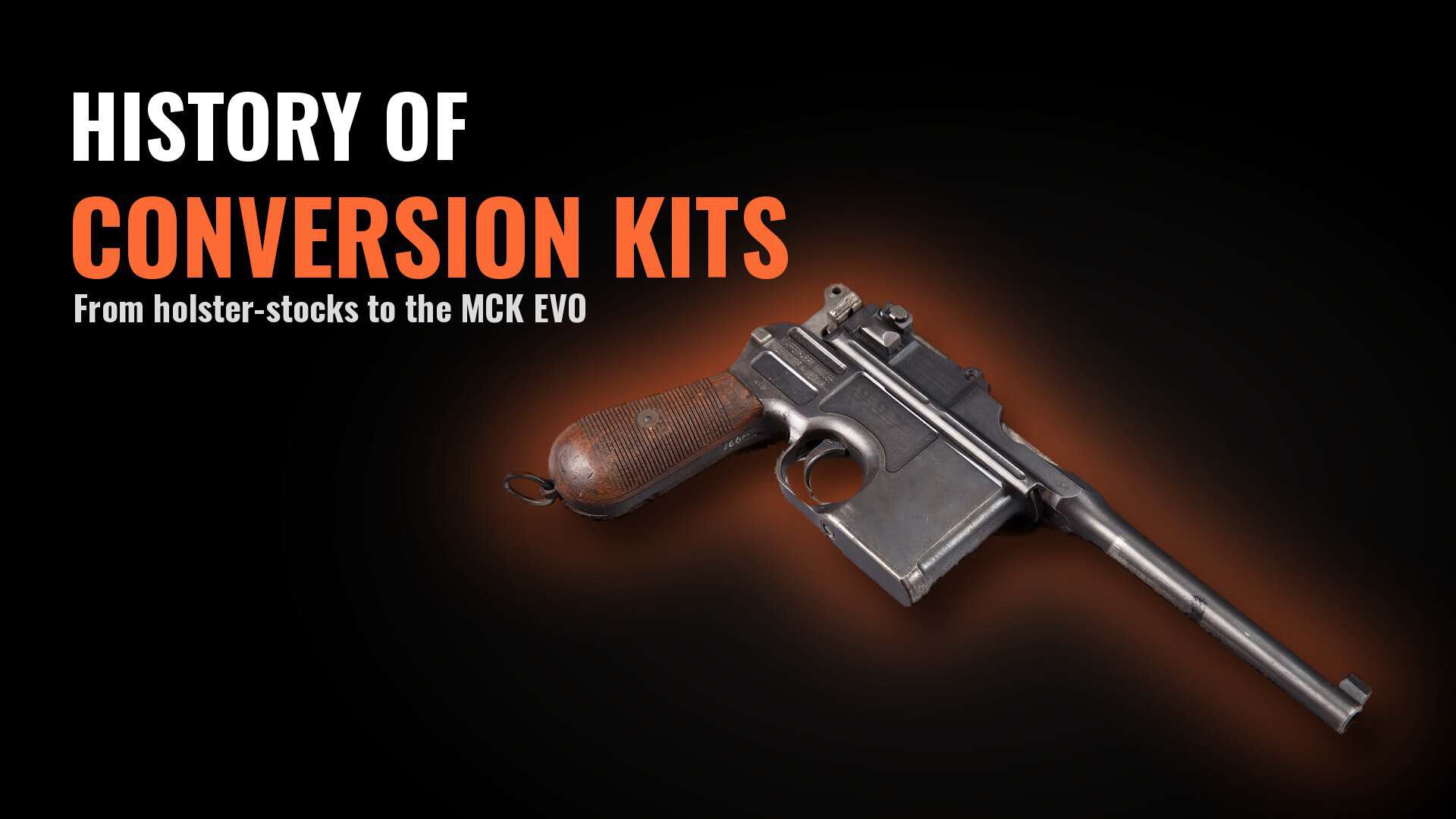
Putting a stock on a pistol is not a new idea. Shooters were doing it more than 125 years ago. The tools changed, the laws changed, and the gear got a lot lighter. But the goal stayed the same: take a handgun you already trust and make it steadier and easier to shoot well.
Here is how we got from wooden holster-stocks on Mauser “Broomhandles” to today’s MCK EVO chassis.
A pistol conversion kit is anything that adds a stock or brace and more contact points to a handgun without turning it into a different gun. Your pistol still does the shooting. The kit just gives you a better way to hold it. Early designs bolted a stock onto the grip. Modern kits wrap a full chassis around the pistol, with rails, a charging handle, and a folding stock or brace.
The Mauser C96 is where most people start the story. Mauser built it from 1896 to 1937. It had a long barrel, a box magazine in front of the trigger, and a grip shaped like a broom handle, which is how it got the “Broomhandle” nickname.
Its most famous accessory was a hollow wooden shoulder stock. The pistol rode inside the stock as a holster or carrying case. When you needed more control, the stock clipped onto a slot cut into the back of the grip. The M1898 pistol carbine was the first model cut for that combination stock-holster.

That gave the C96 the steadiness of a short carbine in a package you could still wear on your belt. Think of it as the great-grandfather of every conversion kit.
Germany took the idea further with the Luger. On July 2, 1913, the Kaiser authorized the Lange Pistole 08, better known as the “Artillery Luger.” It had a 200 mm (7.9 in) barrel, an 8-position tangent rear sight, and a board-type wooden shoulder stock with a leather holster attached.
The stock locked onto a lug on the heel of the pistol frame. The idea was simple. Artillery crews and other troops could carry a pistol day to day, then snap on the stock and use it like a carbine when things got close.

In the U.S., the big turning point was the National Firearms Act. It was enacted on June 26, 1934. The NFA put short-barreled rifles, machine guns, short-barreled shotguns, silencers, and “any other weapons” under a registration and tax system. The tax was $200, which was a lot of money in 1934.
Because a pistol with a shoulder stock could count as a short-barreled rifle, stocking a handgun in America became a regulated move. Some original stocked pistols, like certain Broomhandle Mausers with their original stocks, were later taken off the NFA list as collector’s items. New builds did not get that pass.
The law has kept changing. Starting January 1, 2026, the federal tax on short-barreled rifles dropped from $200 to $0, but they are still NFA items. For how this applies to an MCK, read our post on whether an MCK makes your pistol an SBR.
Quick note: this is general history, not legal advice. Federal, state, and local rules vary and change. Check the current law where you live before you buy or build.
The Browning Hi-Power came out in 1935. It is often called the P-35 for that reason, and Belgium adopted it for military service that same year. Some versions carried a tangent rear sight, and Inglis in Canada built a version with an adjustable rear sight and a detachable shoulder stock, mainly for a Nationalist Chinese contract.

By this point, the pattern was set. A good service pistol, a detachable stock, and a sight built for longer shots.
Old holster-stocks did one job: give you a shoulder contact point. They did not add rails, optics mounts, or a better way to run the slide. Modern conversion kits changed that. Instead of hanging a stock off the grip, they surround the whole pistol with a lightweight chassis.
That shift matters most for today’s polymer pistols, especially Glocks. A good chassis gives you a top rail for a red dot, more grip surface, a charging handle, and a folding stock or brace, all without permanent changes to the gun. If you want to know which handguns can be converted, see our guide to the types of pistols that can be converted.
CAA was one of the pioneers of the modern handgun conversion kit with the MCK (Micro Conversion Kit) series. Today the MCK has models for 125+ handguns, from Glock, Sig Sauer, Smith & Wesson, Springfield, CZ, Taurus, Ruger, Canik, and more. CAA is also the exclusive licensee of the SB Tactical patent for the brace on handgun conversion kits.

Each generation fixed something shooters asked for:
For a side-by-side look, see the main differences between the MCK 1.0, 2.0, 3.0, and MCK EVO or our MCK Buyer’s Guide. Not sure which gen your Glock is? Start with How To Tell What Gen Your Glock Is?.
In April 2025, CAA came back under new ownership with a new support team and restored inventory. You can read the full story in A New Chapter for CAA: We’re Back.
On September 12, 2025, brothers Joe and Anthony Parisi announced they had acquired CAA USA. They co-founded Plastimold Products, the Florida manufacturer that had been building the MCK behind the scenes. As Joe put it, “If you own an MCK, we made it.” More in our announcement.
Plastimold has offered injection molding and precision machining since 1999. In 2022, Joe and Anthony also helped launch META Tactical, the team behind the APEX bullpup kit and the MX-1 Glock chassis. Now Plastimold, META Tactical, and CAA USA run as one family, with R&D, machining, and assembly under one roof in Delray Beach, Florida. Here is what that means for you.
In February 2026, we introduced the MCK EVO. It takes everything learned from the MCK 1.0 through 3.0 and builds one smarter platform. Older MCK models were made for specific pistols. If you owned a Glock 19 and a Sig P320, you needed two kits. The EVO works with 100+ handguns from Glock, Sig, Smith & Wesson, Springfield, FN, and more.

Running a Glock 17, 19, or 45 Gen 6? Add the Beavertail Expansion for EVO Glock 17/19/45 Gen 6. Read the full launch story in Introducing MCK EVO, or check what to look for in a Glock conversion kit.
| Year | Milestone |
|---|---|
| 1896 | Mauser C96 enters production. It later becomes famous for its hollow wooden holster-stock. |
| 1898 | The M1898 pistol carbine is the first C96 cut for the combination stock-holster. |
| 1913 | The Artillery Luger (LP 08) is authorized on July 2, with a 200 mm barrel and a board stock. |
| 1934 | The National Firearms Act is enacted on June 26, putting short-barreled rifles under a $200 tax and registration. |
| 1935 | The Browning Hi-Power is introduced. Later versions add a tangent sight and a detachable stock. |
| Modern era | CAA builds the MCK 1.0, 2.0, and 3.0 conversion kits. |
| 2022 | Joe and Anthony Parisi help launch META Tactical. |
| Apr 2025 | CAA relaunches under new ownership. |
| Sep 2025 | Joe and Anthony Parisi announce their acquisition of CAA USA. |
| Jan 2026 | The federal NFA tax on short-barreled rifles drops from $200 to $0. |
| Feb 2026 | CAA introduces the MCK EVO, one chassis for 100+ handguns. |
The C96 and the Artillery Luger proved the idea more than a century ago: a stock and a steadier hold make a good pistol better. The MCK EVO brings that idea up to date with a slim chassis, rails, and a folding stock or brace, and no permanent changes to your gun. If you shoot a Glock, it is the easiest way to see what your pistol can really do.
Photo credits: Mauser C96 with holster-stock by Gary Todd, CC0; Artillery Luger (LP 08) by Daderot, National WWI Museum, public domain; Browning Hi-Power with shoulder stock by Gabon100, CC BY-SA 4.0; Mauser C96 (featured image) by Auckland Museum, CC BY 2.0. Licenses: CC BY-SA 4.0, CC BY 2.0. Some photos were cropped and annotated; annotated versions are shared under the same license. All other photos: CAA USA.

 1st Responders Discounts
© 2026 RIGHTS RESERVED CAA USA LLC // Meta Tactical LLC // Proudly Designed, Developed & Made in the USA By Plastimold Products LLC


